
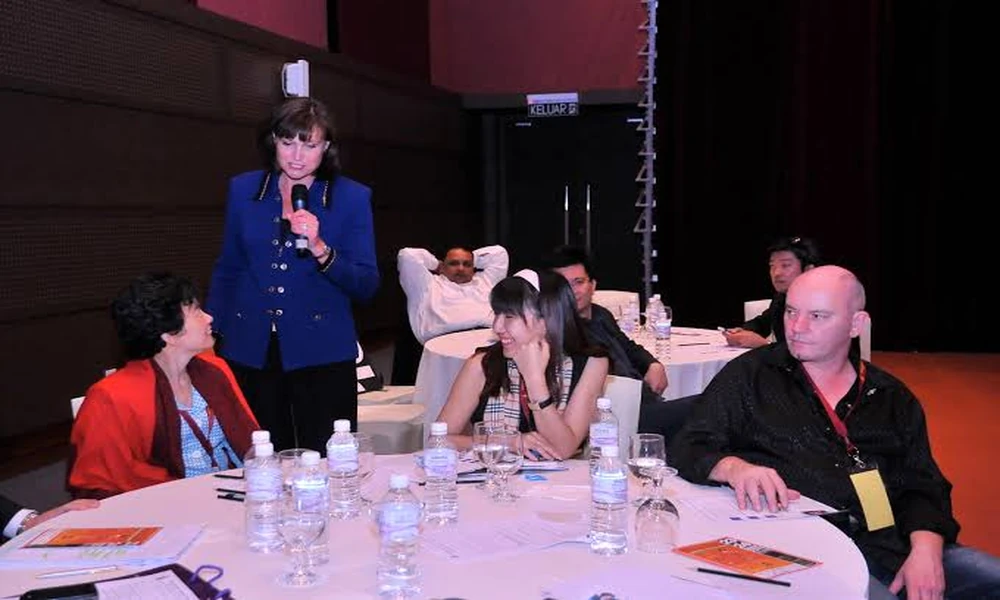
A useful panel excerpt preserves enough of the question and its context for the answer to remain accurate. Before recording a professional learning discussion, plan how speakers will be identified, how questions will be captured and who will review extracted clips. A memorable sentence is not automatically a fair standalone representation of what someone said.
The impressive sentence is not always the useful clip
A panellist may offer a confident answer to a very narrow question. Remove the question and the answer can appear to apply much more broadly. The problem is not necessarily the speaker’s wording. It is the change in context created when a discussion is converted into a short public asset. That makes clip selection an editorial responsibility, not simply a search for energetic moments.
Listen for conditions attached to an answer. A speaker may be describing one organization, one stage of a project or a hypothetical situation. Those limits can be essential even when they make the excerpt less compact. A useful educational clip gives viewers enough information to understand what is being discussed without assuming they attended the session.
Also consider whether the point emerged through disagreement. One panellist’s answer may have been challenged or refined by another. Extracting only the first statement can erase the learning value of the exchange. A slightly longer sequence may better represent the discussion, or the moment may simply be unsuitable for a short clip.
Brief the moderator before the recording team
The moderator can help create a clearer record without making the live session feel scripted. Explain that recordings may later be used outside the room and discuss how questions will be stated. A question that exists only as a vague reference to a slide or a previous conversation can be difficult for a later viewer to interpret.
Agree on how audience questions will enter the recorded discussion. The event’s own participation and recording arrangements should guide what is appropriate. A moderator may need to repeat or summarize a question for the room, but that summary should preserve its meaning. The production team should know the plan before the discussion starts rather than trying to infer it while several people are speaking.
Provide the moderator with correct speaker names and the approved way of describing their roles. Confirm how those details will appear in the programme and in the finished video. The camera crew should not have to deduce someone’s title from an old online biography during post-production. Accurate preparation reduces the need for last-minute corrections.
Identify who is speaking without interrupting the discussion
A person watching an extract may never see the panel’s opening introductions. Decide how each clip will identify the relevant speaker and establish the subject. A brief on-screen label or introductory line may help, depending on the format. The identification should be accurate and readable without requiring the viewer to remember the seating order from a longer recording.
Toronto event planners can read the event-videography service overview from Indigo Visual when considering how to brief recording coverage. Describe the intended full-session record and any shorter extracts separately. Confirm the actual recording, editing and delivery scope with the provider; the ability to capture an event does not mean every possible set of clips is automatically included.
Give the production team the practical information it needs about the room, microphones, stage layout and discussion format. The relevant people should coordinate the arrangements rather than treating audio and video as unrelated bookings. A visually clear answer is of limited value if the question is missing or the speaker cannot be heard in the recording.
Keep the live experience in view. Participants came for a discussion, not repeated interruptions to improve a future edit. The recording plan should support the event’s format and identify realistic limitations. If a particular camera angle or pickup is not feasible, discuss alternatives before promising a polished result that depends on it.
Edit the context before the length
Start the selection process by writing a plain-language description of what each proposed excerpt says. Include the question, the relevant condition and the answer. If those elements do not fit the chosen fragment, look for a longer passage or a different moment. Setting a rigid duration first can encourage edits that preserve pace while discarding meaning.
Review the extract independently of the full recording. Someone familiar with the event may unconsciously supply missing context and fail to notice that a new viewer would be confused. Ask a reviewer who understands the subject but did not attend to describe the point they hear. Their response can reveal an ambiguity before the clip is distributed.
Handle corrections through an agreed process with the organizer and appropriate speakers or reviewers. Distinguish factual errors from a wish to make an answer sound more polished. Do not manufacture a new statement by combining fragments in a way that changes the speaker’s meaning. Where an accurate excerpt cannot be made from the available material, omission is an acceptable editorial decision.
Label an extract as an extract
Give the finished clip an accurate title and enough event information to place it. Avoid headlines that turn a nuanced exchange into an absolute claim. If viewers can access the full discussion, explain where it is available through the organizer’s chosen publication route. Do not imply that a short selection contains the whole argument.
Check captions and speaker labels against the approved version, especially names and technical terms. The written layer is part of what viewers learn from the video. A correct soundtrack can still be undermined by a misleading title or a caption that changes an important word. Review the actual final file, not only the editing notes.
Some answers need their question, a qualification and the response of another speaker to be useful. Let those excerpts be longer, or leave them in the full recording. A panel’s value often lies in the relationships between ideas. Preserving that value is a better reason to publish a clip than meeting an arbitrary demand for one more short asset.