
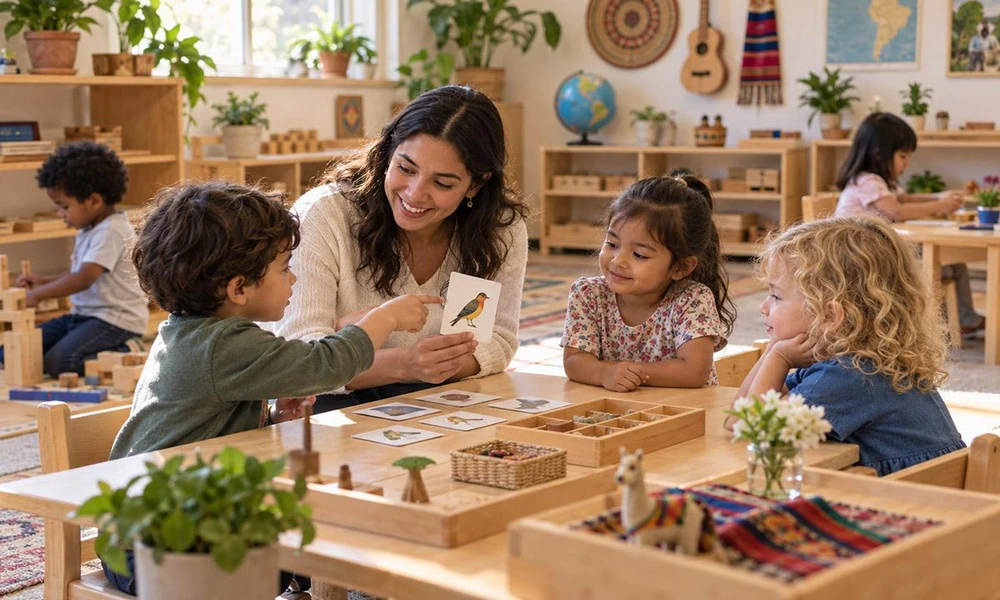
Montessori’s hands-on materials, mixed-age classes, and focus on the early years of language make it a natural home for Spanish. Children learn words by handling real objects and hearing them in daily routines. Research shows that learning two languages does not cause speech delays, though claims of a “brain boost” are less settled. At KV Montessori Academy in Eastlake, daily Spanish lessons are part of the primary programs.
Montessori Spanish immersion is not a trend stitched onto an old method. The two approaches rest on the same belief: young children learn best by doing, surrounded by real objects and people who use language for real reasons. Put them together, and a second language becomes part of ordinary classroom life.
You may be hoping your child grows up with Spanish. Maybe it is your family’s first language and you want it to stay strong. Perhaps Spanish is new to your home, and you want your child to be introduced to it early.
Either way, you probably have questions. Will two languages confuse a toddler? Can a child-led classroom make room for Spanish?
This article explains why the two approaches fit so naturally, how the classroom turns everyday work into language practice, and what research does and does not promise. It closes with practical ideas on what to look for when you tour a program.
Why Montessori and Spanish Immersion Fit So Naturally
Montessori was designed around how children under six take in language from their surroundings. Immersion works the same way: Spanish is used for real tasks, not taught as a separate subject. When the two are paired, Spanish can travel along with everything a child already does during the day.
The Absorbent Mind and the Sensitive Period for Language
The AMI glossary of Montessori terms describes the “absorbent mind,” the way children from birth to six soak up their world. It also describes “sensitive periods,” passing windows of intense, self-motivated interest. Language is one of them.
A window is not a deadline, though. The American Academy of Pediatrics and ASHA note that older children and adults learn languages too.
Spanish as the Medium, Not the Subject
AMI’s guidance on introducing a second language favors immersion over isolated classes. It suggests children absorb a language best from a native speaker who uses it naturally in the environment.
How the Prepared Environment Becomes a Language Environment
A “prepared environment” is a classroom arranged on purpose, with child-sized furniture and real materials on low, orderly shelves. You can read more about the Montessori prepared environment and how it is organized.
For a language learner, every shelf is a set of things to name. As a three-year-old works with a pouring tray, an adult might name what she uses: la jarra, el vaso, or despacio. The words arrive while the objects are in hand.
Practical Life: Vocabulary You Can Pour and Button
“Practical life” is the Montessori name for everyday care activities like pouring, sweeping, buttoning, and setting a table. The American Montessori Society describes this work as a foundation for independence. Each task also pairs a movement with an action word.
“Grace and courtesy” lessons work the same way. Greeting a friend, saying thank you, and asking for a turn happen many times a day, so children hear these phrases often.
The Materials That Make New Words Stick
Montessori language materials move a child from a real object to a picture to a written word in small steps. Because they are visual and hands-on, they work just as well in Spanish. A child can match, name, and later read new words without translation.
Three-Part Cards
A set of Montessori three-part cards includes a picture card, a word card, and a control card showing both. Younger children match objects and pictures, while older preschoolers match pictures to printed words, like la manzana or la pera.
The Three-Period Lesson
Montessori teachers often introduce new words in three steps. First, “This is la manzana.” Next, “Show me la manzana.” Finally, “What is this?” The middle step helps second-language learners because a quieter child can point to show understanding before feeling ready to speak.
Later, sandpaper letters and the moveable alphabet connect sounds to symbols. AMI notes that children from three to six begin refining spoken language through written symbols.
Mixed-Age Classrooms Give Children Language Mentors
Montessori classrooms group children across three-year age spans. The American Montessori Society notes that these age spans encourage mentorship, and its FAQ explains that younger children learn a great deal by watching older ones.
When a four-year-old asks for a turn in Spanish, a younger child hears a phrase that is realistic to copy. KV’s classrooms follow a multi-age, three-year cycle, and you can learn more about the benefits of mixed-age classrooms.
Immersion Models, and Where Montessori Fits
Not every bilingual program organizes language the same way. Many elementary dual language programs divide the day by time. According to the Center for Applied Linguistics, a 90/10 model uses the partner language for most of the day in early grades, while a 50/50 model splits time evenly.
Other programs connect each language to a person, which fits AMI’s preference for a native-speaking model. AAP and ASHA say there is no single right way to raise a multilingual child.
An AMS article on Montessori dual language programs describes schools that present materials in both languages and draw on the sensitive period for language. KV Montessori Academy describes an immersive bilingual setting, with daily Spanish lessons integrated into its primary programs.
What Research Says (and What It Doesn’t)
Research shows that learning two languages does not cause speech or language delays, and mixing words from both is a normal stage. Claims that bilingualism reliably boosts focus or “brain power” are less settled. The language itself remains the strongest reason to choose Spanish.
No Confusion, No Delay
AAP and ASHA explain that most children say first words around 12 months, whatever the language count, and usually separate their languages by about age three. A National Academies report also found no evidence that learning two languages from birth to five poses a developmental risk.
Exposure Matters
In a study of bilingual toddlers, growth in each language tracked how much children heard it, so meaningful Spanish at school and at home both count. Zero to Three adds that, counting both languages, bilingual toddlers’ vocabularies look similar to those of children learning one.
The “Bilingual Advantage” Debate
Some studies suggest bilingual children have sharper focus, but larger reviews are more cautious. A 2021 meta-analysis of more than 23,000 children found a small effect that faded after correcting for publication bias (positive results getting published more often). For more on myths, see what research shows about bilingual education for toddlers.
“The best reason to choose Spanish is Spanish itself: the people, stories, and connections it opens.”
Choosing a Montessori Spanish Immersion Program
Look past the label. A strong program pairs trained Montessori teachers with natural Spanish across the day, respects each child’s home language, and partners with families. Visit, listen to how adults talk with children, and ask how Spanish is organized.
On a tour, ask who speaks Spanish with children and how it shows up in materials and routines. Ask how the school supports a child who arrives speaking only English or only Spanish. NAEYC encourages programs to treat every home language as a strength.
At home, keep speaking your own language with warmth. Zero to Three encourages schools to partner with families on this issue. If Spanish is new to your family, books and music in Spanish can help add exposure.
What Spanish Looks Like at KV Montessori Academy
KV Montessori Academy creates an immersive bilingual setting for children from 18 months to 6 years. Daily Spanish lessons are integrated into our Primary and Primary Advanced classes, and all our teachers are Certified Montessori Guides. Explore our Toddler, Primary, and Primary Advanced programs to see how each class works.
Key Takeaways
- Montessori and Spanish immersion share one idea: children learn language by using it for real tasks.
- Practical life, three-part cards, and mixed-age classes give children many natural chances to use Spanish.
- Learning two languages does not cause speech delays, and mixing them is a normal stage.
- Big “brain boost” claims are debated, so value bilingualism for communication and connection.
- On a tour, ask how and when Spanish is used each day.
Every child develops at their own pace, and language growth varies from child to child. This article is general educational information, not a guarantee of specific outcomes. If you have concerns about speech, speak with your pediatrician.
Conclusion: Hearing Spanish in a Montessori Day
A bilingual start is less about rushing ahead and more about connecting with family, neighbors, and a wider world. Montessori provides a calm, hands-on environment where new words are introduced through real objects.
Curious what a Montessori day actually looks like for your child? Come see it in person. KV Montessori Academy welcomes families in Eastlake and Chula Vista to tour our classrooms and meet our teachers. You are welcome to bring your child along.
Schedule a Tour or call (619) 730-4020.
Frequently Asked Questions
Will learning Spanish and English at the same time confuse my toddler?
No. The American Academy of Pediatrics and ASHA note that learning more than one language does not cause speech or language problems. Most children separate their languages by around age three, and mixing words from both is a normal stage.
What is the sensitive period for language in Montessori?
It is Dr. Montessori’s term for the early years, roughly birth to six, when children show intense, natural interest in sounds and words. It is a window of strong readiness, not a deadline. Older children and adults can still learn new languages.
Do we need to speak Spanish at home for our child to benefit?
No. Families can continue using their home language with confidence. Growth in each language follows how much meaningful exposure a child gets, so Spanish books and music can add support.
Is Montessori Spanish immersion the same as a dual language school?
Not exactly. Elementary dual language programs often use set time splits like 90/10 or 50/50. Montessori programs may weave Spanish into materials and routines instead, so ask each school how it organizes Spanish.
How is Spanish part of the day at KV Montessori Academy?
KV Montessori Academy creates an immersive bilingual setting where children build language skills through hands-on learning. Daily Spanish lessons are integrated into the Primary and Primary Advanced classes. Scheduling a tour is the best way to see it in action.